

Many teams are starting to use micro apps because they solve one clear problem without dragging in a whole complex system. These small, gap-filling applications focus on fixing specific workflow issues, which makes them easier to build, easier to use and faster to deploy than traditional applications that require a major software upgrade. As a result, teams can quickly develop and implement micro apps to resolve immediate needs rather than waiting for a major software upgrade.
This approach is highly preferred by businesses, as it not only saves time but also avoids the heavy setup that comes with large enterprise tools. Furthermore, with the integration of these apps with BI dashboards like Power BI, teams have access to live data, making internal decisions faster and more confident.
Agile development plays a big role here, since it supports rapid micro app development without slowing things down. It allows teams to easily build, test, and adjust quickly so the app truly matches the gap it’s meant to fix in the first place and therefore, this mix of speed, simplicity, and clarity is exactly why micro apps are becoming the most widely used option for fixing internal workflows.
Micro apps fit naturally with Agile because they’re small, focused, and easy to break into clear tasks. Since Agile works in short cycles, these lightweight apps fit perfectly into this development process. Each part of the app can be built, tested, and improved quickly and independently without slowing down the entire project.
Because micro apps are simpler by design, teams can prototype and validate ideas much faster. It becomes easy to try something, get feedback, and adjust right away. This is especially helpful when using low-code platforms or working in a microservices setup, where modular development is the norm.
When you combine agile development for micro apps, the result is faster delivery as well as quick ROI. Instead of waiting for months for the value of a large development project, every small release provides immediate improvements, making the whole process smoother and more cost-effective.
Agile speeds up micro app creation because everything is built in small steps. Instead of working on a big project all at once, teams break it down and deliver one piece at a time. These shorter, focused cycles make it easier to stay on track and fix issues before they grow.
Feedback loops are exceptionally valuable. Users can provide feedback on early versions of the app, share what works, and point out what doesn’t. This process minimizes the need for extensive redesign and makes sure the app is built the right way from the start. Because users are part of the development process from the beginning, the team always has clear, accurate requirements.
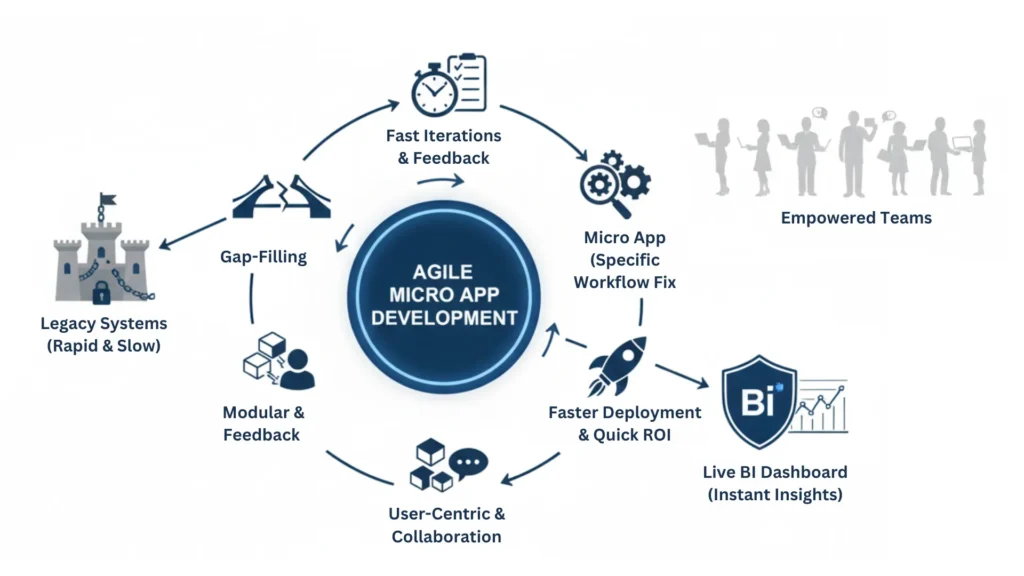
Micro apps gather the exact workflow data teams need, without all the extra noise that larger systems often include. Since the data is so focused, it becomes much easier to understand what’s really happening in a process. When this information flows straight into Power BI dashboards, leaders get clear, real-time insights without waiting for reports.
Through the use of business intelligence micro apps along with BI dashboards, teams are able to quickly detect trends, problems, and potential opportunities. It turns everyday actions into useful information that supports quicker decisions. An example of this is a small micro app that tracks inventory gaps and can feed live data into a Power BI dashboard, instantly showing demand patterns and helping teams plan better. Together, these tools creates quick, practical intelligence that improves operations right away.
Choose micro apps when you need a clear gap-filling application for a specific workflow.
Pick them when the business needs a fast turnaround without long delays.
Use micro apps when legacy systems are too hard or slow to change.
They’re also the right choice when BI and small internal workflow apps already provide enough value without replacing entire platforms.
Agile development for micro apps makes creating solutions faster, more flexible, as well as more collaborative because teams can build, test, and improve in short cycles. Micro apps deliver practical value quite quickly, and when combined with BI dashboards, they provide instant insights that help businesses act smarter and faster. This approach turns small, gap-filling applications into high-impact tools without the delays of traditional development.