
Most businesses start with off-the-shelf workflow tools because they’re quick to set up and easy to use. At first, they boost productivity and help teams stay organized. But as the business grows, things slowly get more complicated. New processes appear, teams expand, and suddenly the tool that once worked fine starts feeling limiting.
Although these tools are designed to fit many companies, they rarely fit your exact way of working. Because of that, teams begin using workarounds, adding manual steps, or creating shadow processes outside the system. In addition to wasting time, these actions lead to errors, frustration, and low productivity.
Thus, what once saved time now creates delays. That’s where custom workflow software comes in. Since it’s built around your real processes, it adapts as you grow, thereby becoming a long-term solution rather than a temporary fix.
Businesses turn to workflow automation software as they need things to be quicker. It should not take days to get approvals and it should not necessitate follow-ups on simple tasks. The goal is smoother execution so teams can focus on real work instead of waiting.
They also expect less manual work. Since automation promises efficiency, people assume data will flow easily between steps. This may seem easy, but many business workflow tools still need manual inputs, checks, and fixes, which slows everything down.
Another big expectation is visibility and accountability. Managers want to see who owns what and where work is stuck. But as processes change, these tools often struggle to keep up. Thus, although the expectations are high, reality doesn’t always match because most tools were not built to scale as workflows evolve.
Off-the-shelf tools are built to work for everyone, but that is also their biggest weakness. Because they follow a one-size-fits-all design, they rarely match how a business actually operates. Although they may cover basic needs, they often fall short once real-world complexity shows up.
Customization is usually limited. You can tweak a few settings, but deeper changes are locked away. Thus, teams are forced to change their processes to fit the tool, instead of improving the process itself. This leads to awkward steps, extra approvals, and workarounds that slow things down.
Another issue with off the shelf software limitations is cost. Useful features are often hidden behind add-ons or higher plans. Since data access and integrations are also restricted, businesses struggle to connect systems properly, thereby losing efficiency instead of gaining it.
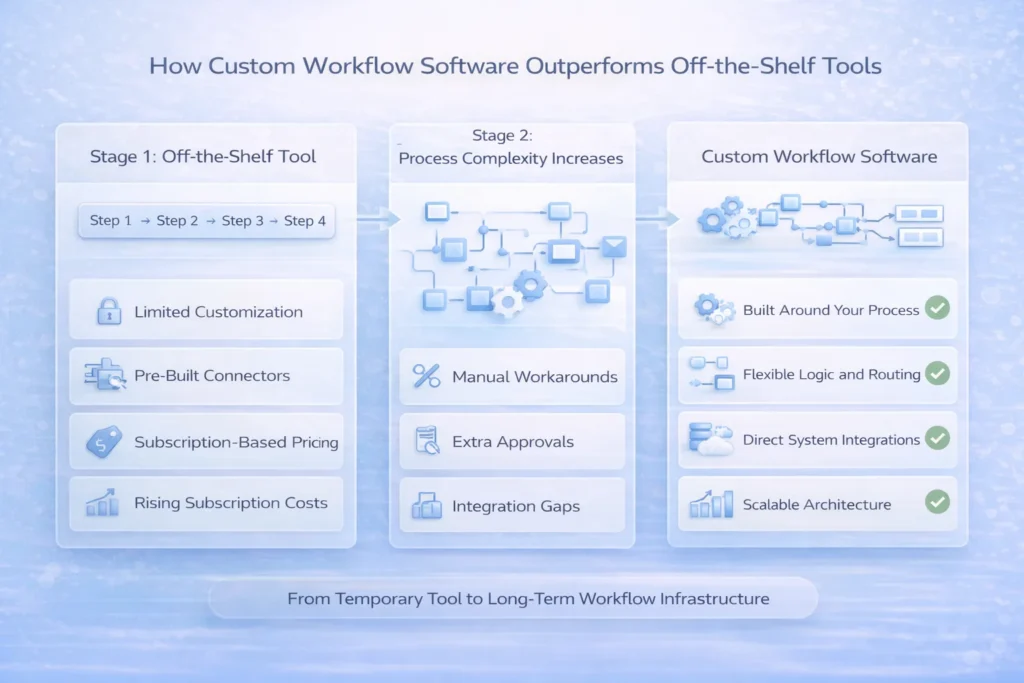
Custom workflow software is designed around how a business already works. Instead of forcing teams to follow a fixed structure, it supports existing processes. Because of this, employees don’t have to change their habits just to use the system.
It is also flexible when it comes to logic, routing and rules. Despite the fact that all businesses approach work differently, custom systems can match those exact needs. Thus, approvals, triggers, and actions happen in the right order, without any extra steps or confusion.
Since operations are rarely the same across companies, custom automation solutions adapt to unique requirements. They are designed to develop as the business expands, not just to function today, thereby supporting long-term efficiency and change.
As a business grows, unforeseen operational challenges start to appear. Edge cases become more common, but many business workflow tools are not built to handle them. Although the tool may work for simple tasks, as the process flows become increasingly complex, it may have difficulty executing properly.
More users, more data, and more approvals can slow things down. As pricing is often based on users or features, licensing costs rise rapidly resulting in increased costs without real value.
Custom workflows scale differently than traditional workflows. Because they are built for specific needs, they can handle growth without major changes. Therefore, instead of reworking the entire structure, the system grows smoothly along with the business.
Off-the-shelf tools usually depend on pre-built connectors. Although these connectors are easy to use, they are often limited. Since they only support common use cases, deeper integrations with core systems can be difficult or even impossible.
In contrast, custom automation solutions connect directly with the systems a business already uses. Because the workflows are designed from scratch, workflow automation software can pull and push data exactly where it’s actually needed. This reduces data duplication as well as avoids sync errors.
Thus, automation becomes cleaner and more reliable. With fewer workarounds and manual fixes, the overall system stays simple, stable, and easier to manage over time.
With custom workflow software, businesses get full access to their workflow data. There is nothing hidden behind limits or or restricted views unlike locked systems. Because every data is accessible, teams can see exactly how work moves through each step.
Custom reporting and analytics make this even more powerful. Although standard tools offer basic reports, custom systems can track cycle times and identify constraints. Therefore, issues can be addressed more easily before they grow.
Because decisions are based on real data, leaders can plan better and improve operations with confidence.
Over time, many companies are experiencing subscription fatigue. User-based pricing and feature upgrades only add to the cost. One of the major off the shelf software limitations is paying again and again, even for features that are never used.
Custom software works differently. Although the upfront cost may be higher, it becomes a long-term asset. Since there are no constant license fees, costs stay predictable.
Thus, over time, return on investment improves. The software grows with the business, thereby delivering real value instead of ongoing expenses.
Custom solutions make sense when workflows are complex or don’t follow a standard path. Many workflow software for businesses tools work fine for simple tasks, but they struggle with exceptions and special rules. Since real operations are rarely simple, flexibility becomes important.
High-volume approvals are another case. When hundreds or thousands of requests move daily, small delays add up. In regulated environments, rules must be followed closely, although off-the-shelf tools often fall short.
Custom software also works better for multi-system operations. Because everything connects smoothly and scales over time, it supports long-term growth without constant rework.
The first step would be to choose high-impact workflows. Focus on those areas that trigger delays or errors since improvements there deliver fast results. Custom workflow software works best when it solves real problems first.
Next, map current processes and compare them with future goals. Even though it is tempting to automate all of it, it would be wise to know what has to change. Engaging end users early is also effective since they know the work best.
Design with change in mind. Processes evolve, so systems should too. Finally, measure outcomes, not just automation. Time saved, errors reduced, and better decisions matter more than flashy features.