
Businesses collect massive amounts of data every day from sales numbers, marketing campaigns, operations logs, to customer interactions. But having data doesn’t automatically make decisions easier.
Analytics dashboards show trends and charts, but they don’t exactly tell you what action to take. The real value comes when data is translated into simple, actionable intelligence that helps develop successful business strategies.
This is accomplished through Business Intelligence, which helps teams interpret raw data and understand how to use it to help them make more informed business decisions.
Business intelligence is the practice of turning data into meaningful insights that help companies make better decisions. It goes beyond basic reporting or dashboards because it focuses on context, trends, and action.
Modern organizations rely on business intelligence solutions and business intelligence services to unify data, provide consistent metrics, and deliver insights in ways everyone can understand.
Data is often scattered across multiple systems like CRMs, ERPs, spreadsheets, and ad-hoc tools. Different teams might define metrics differently, causing confusion.
Without context, raw numbers don’t tell a story. A spreadsheet full of figures may look complete but leaves decision-makers unsure of the next steps.
This is why it’s essential to simplify complex business data and make it easy to understand, so that decisions can be made quickly as well as confidently.
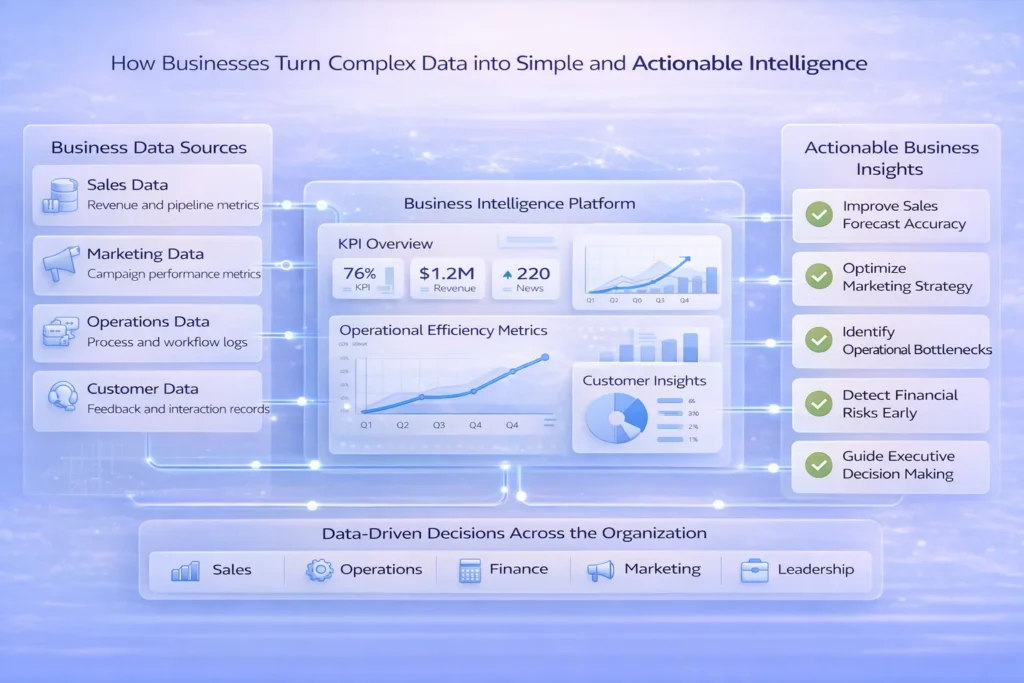
Business intelligence solutions organize and clean data to make it usable. Data modeling and normalization create consistency across sources.
Centralized data warehouses and semantic layers unify metrics, while tagging, categorization, and hierarchies make analysis simpler. BI tools then turn this structured data into visuals like charts, dashboards, and natural-language summaries, so everyone can understand it.
In short, BI is all about turning data into insights that are clear, actionable, and easy for teams to act on.
The BI process breaks down complex data into practical steps:
This process helps with data driven decision making and ensures your team is transforming data into decisions rather than simply analyzing a bunch of numbers!
Sales: Monitor pipeline health and forecast accuracy to improve revenue planning.
Operations: Find the bottlenecks and streamline operations to save time and cost.
Finance: Evaluate budget variances and spot risks early.
Marketing: Track campaign performance and optimize channels.
Executive Leadership: View KPI dashboards to have an overview of the company performance.
These examples show how businesses use data insights in real-life situations and why business analytics for executives is becoming quite essential.
Technology alone isn’t enough. Teams must be empowered to ask analytical questions and act on the answers.
Building a culture where insights guide actions requires training, literacy, and accountability. Employees should feel confident using BI tools to make decisions.
A strong culture ensures data driven decision making isn’t just a process but it’s how the company operates.
Adding too many metrics to the dashboards may overwhelm users. Improperly defined metrics are confusing.
Misalignment between analytics teams and business units slows adoption and ignoring context and storytelling reduces the value of insights.
Lastly, failure to measure the outcome of decisions prevents learning. Decision-oriented analytics ensures insights lead to real impact.
Modern BI platforms should do more than show reports. They should turn data into actionable intelligence, unify sources, and make metrics easy to understand.
Generic reporting tools provide numbers, but business intelligence services create insights that guide decisions. Professional BI services are worth considering when your company wants structured guidance, custom dashboards, and support for scaling BI across teams.
Data is valuable only when it leads to action. Business intelligence transforms complexity into clarity as well as provides clarity, which in turn helps companies to make quick, smarter decisions.
The real competitive edge comes not just from collecting more data but from being able to turn data into actionable insights and incorporating intelligence into everyday operations.
Professional BI support can help businesses get the most value from their data and make intelligence a baseline capability.