
AI is no longer experimental for leading companies. What started as testing and pilots has now become real execution. AI adoption in competitive businesses is accelerating because companies see that speed and intelligence directly impact growth.
Earlier, competitive advantage was about having access to data. But today, everyone has data. The only differentiator now is the speed, how fast you can use it. This is where LLM integration plays a key role, because it helps businesses turn information into insights and action almost instantly.
Large Language Models are not separate tools any longer; they are now becoming part of the everyday workflows supporting teams, answering queries, summarizing information, and improving decisions. Companies that have integrated Large Language Models into operations are ahead of their competition.
LLM integration in business is much more than adding a chatbot to your website. It means connecting a large language model directly to your company’s systems, data, and workflows. So instead of using AI as a separate tool, it becomes part of how your business actually runs.
There is a significant difference between using public AI tools versus doing true large language model integration. Basic tools can assist individuals with writing and summarizing, whereas enterprise LLM integration integrates AI within internal platforms, dashboards, CRMs, support systems, and analytics tools. Because of that, the AI works with your real data and processes, not generic information.
For example, LLMs can be built into workflows to automate reports, analyze customer feedback, or assist employees with internal queries. LLMs can support analytics by summarizing insights in simple language. They can also enhance customer service capabilities through smart, contextual responses. In short, enterprise LLM integration makes AI part of daily operations and not just an extra feature.
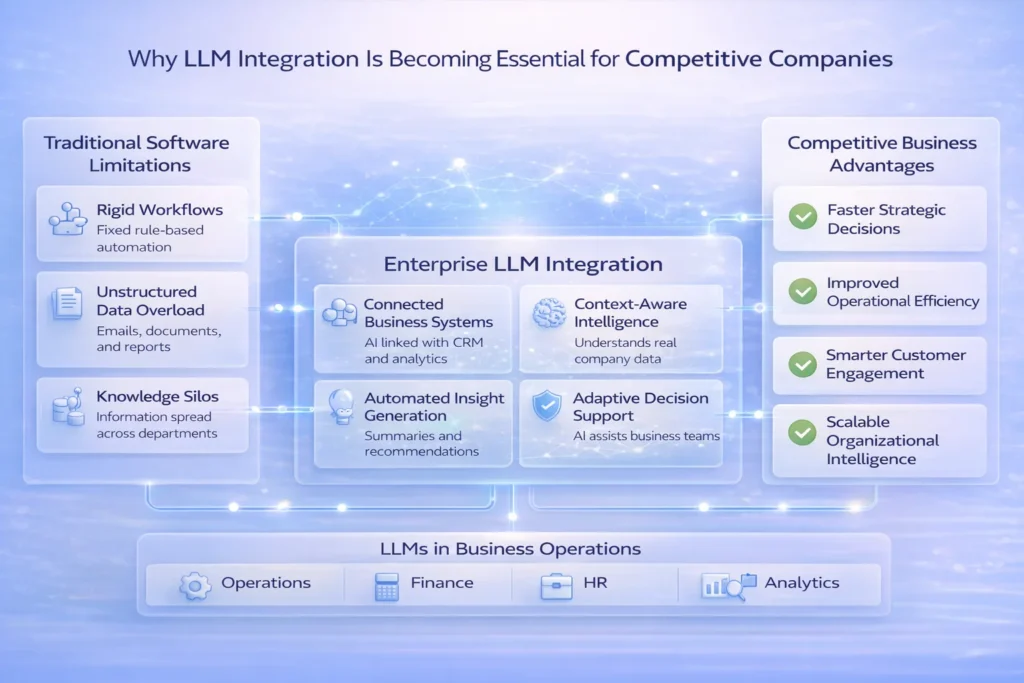
Traditional software works according to set rules in an orderly manner from one action to another. It follows predefined steps. However, given that most of today’s businesses generate large volumes of data in a variety of formats (such as e-mails, pdfs, chat transcripts, contracts, and customer feedback) that are unstructured, rigid workflows can’t understand all of that properly.
Manual decision-making also doesn’t scale. As companies grow, the volume of information increases as well. And as a result, teams get overloaded, and important insights get missed. This is why AI integration for business is becoming necessary, because AI can process large amounts of information quickly and consistently.
Another challenge is knowledge silos. Information sits in different departments and systems. As a result, teams move slower than they should be moving. Static rules cannot adapt to changing situations but AI systems can learn patterns and adjust. That shift from fixed logic to adaptive intelligence is what modern businesses now need.
Many companies start by using standalone AI tools. These tools can help with writing or quick summaries. But since they are not connected to internal systems or real company data, they rarely deliver strong ROI.
The real value comes from context. AI needs access to your workflows, databases as well as daily tools. If AI does not have that connectivity, it works in isolation. This is why LLM integration services focus on connecting models directly to business systems and not just to offer surface-level features.
Enterprise LLM integration makes AI part of the workflow itself. It is no longer something employees need to keep separate from their job, but instead is embedded into dashboards, CRMs, reporting systems, and internal platforms. That’s when AI starts driving measurable impact.
One of the biggest benefits of LLM integration is faster decision-making. Leaders now don’t have to wait days for summaries or analysis. Information becomes easier to understand as well as to act on.
LLMs in business operations also reduce operational friction. Monotonous work, manual searches, and back-and-forth emails are reduced. Teams also spend less time gathering information and more time executing.
Another significant benefit is better use of institutional knowledge. Companies have years of documents, reports, and insights stored away. LLM integration helps use that knowledge and put it in action.
Most importantly, it provides scalable intelligence. Companies can increase output and insight without even increasing headcount at the same rate. That efficiency creates a real competitive edge.
The real impact of LLMs in business operations shows up across departments. In Operations, LLMs help streamline workflows; in Finance, they help summarize and flag anomalies in reports; in HR, they can be used to answer policy queries and provide documentation support; and in IT and analytics, they help interpret system data.
Instead of keeping processes manual and rigid, companies are turning them into intelligent workflows. LLMs analyze inputs, suggest actions, and generate summaries automatically. This shift is similar to how businesses improve efficiency through automation, as explained in our guide on 7 ways workflow automation helps businesses.
However, they are not replacing human decisions at all. They are supporting them. Teams still make final calls, but since they have clearer insights and faster access to information, decisions become smarter as well as more confident.
Enterprises deal with sensitive data on a daily basis. All the customer details, financial figures, and internal strategies should remain confidential. Due to this, compliance and security are not optional. Any serious enterprise AI strategy must begin there.
Accuracy is another problem. LLMs are powerful, but they can still make mistakes. They give answers that sometimes sound right but are not. So companies need checks, monitoring, and human review in place.
Governance matters too. Not everything should be accessible to everyone. There should be clear rules, role-based access, and tracking systems, as without structure, AI can create risk instead of value.
Most enterprises don’t build everything alone. That’s where LLM integration services play a significant role. They help design, implement as well as manage AI systems properly. Many organizations now rely on AI LLM integration services to embed intelligence directly into their core operations.
Generic tools are easy to start with; however, they don’t connect deeply to business workflows. Companies need custom solutions built around their processes. LLM integration services help bridge that gap.
More importantly, they align AI efforts with real business goals. So instead of experimenting randomly, companies focus on measurable outcomes.
A smart enterprise AI strategy starts with business problems rather than models or hype. Just real challenges that hinder the team’s ability to complete tasks quickly and effectively.
Ask simple questions: Where are we losing time? Where are decisions delayed? That’s where AI integration for business can help.
Governance should also be defined early, even if it feels slower at first. Because once AI scales, fixing mistakes becomes harder. Measure impact carefully, then expand gradually across teams.
Speed now defines competition. Fast moving companies are the winners. Since LLM integration speeds up analysis, reporting, and communication, it has a direct impact on execution.
The use of AI in competitive business is introducing intelligence into everyday work. Employees don’t think of it as “using AI.” It just becomes part of their systems.
Meanwhile, AI-native competitors are raising the bar. Customers are demanding quicker response and smarter service. Companies that delay may find it harder to catch up later.
LLMs have moved past innovation projects. They are becoming infrastructure. Similar to the way cloud or data analytics used to.
Competitive companies are integrating intelligence directly into operations through structured LLM integration. That is where the true benefit lies in.
Ultimately, it’s not about simply using AI but it’s about how well you integrate it. And for modern enterprises, that capability is quickly becoming essential. To see how this fits into a complete data strategy, explore our data and analytics solutions.