
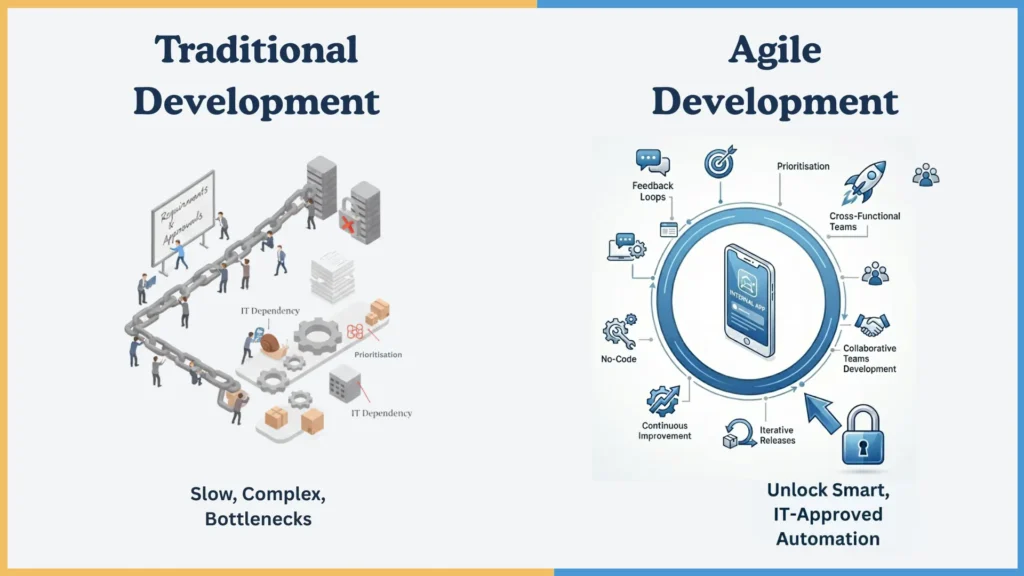
Traditional app development often feels slow and complicated. Teams usually deal with long planning cycles, heavy paperwork, and a big dependency on IT. Because of all these steps, even small changes can take a long time. These development bottlenecks make it hard for teams to move quickly.
But internal teams usually need tools right away. When the app is something people use every day like an approval system or a simple tracking tool, then having to wait several months doesn’t make any sense. Internal app creation works best when updates and fixes can happen fast, not after a long process.
This is why many companies now turn to agile development. Agile breaks work into smaller pieces, so teams can build, test, and improve apps step by step. This leads to rapid software delivery, making it easier to adjust the app as needs change. It also helps people stay involved in the process, so the final tool actually fits what the team wants.
In short, Agile helps businesses move faster and build better internal apps without getting stuck in slow, traditional methods.
Agile is a great fit for internal tools because it works in small, iterative cycles. Teams build a little, test it, get quick feedback, and adjust the scope as needed. These agile principles make it easy to change direction without slowing everything down.
Operational Departments, Financial Departments and Human Resource Departments frequently need quick updates in order to manage their internal workflows that are continuously changing. That’s why the agile methodology for business apps works better than long, traditional methods because it allows teams to collaborate with each other more efficiently, promotes Teamwork Across Departments and helps the app grow in the same direction the business is moving.
With Agile, internal teams can try early prototypes and share thoughts right away. This continuous feedback allows everyone to identify problems sooner, thereby avoiding redoing large portions of work. Because the app grows in small steps and, therefore, it stays closer to real workflow needs. For example, HR might test a leave-approval app every 3–5 days so changes happen quickly. These rapid app development methods facilitate ongoing progress through continuous iterative development.
Agile keeps the focus on what matters most. Teams start with the core features, shaping a simple MVP before adding anything extra. This avoids long delays caused by features nobody really needs. Think of launching an internal reporting tool with only the essential dashboards first. This kind of feature prioritization makes agile software delivery faster and more focused.
Agile brings everyone to the table from day one—IT, operations, analysts, business owners, whoever needs the app. This cuts out the slow handoffs that usually happen between departments. With collaborative development, requirements get clarified faster, and validation happens sooner. These cross-functional teams make agile development for internal apps much more efficient.
Agile delivers small updates regularly to teams as opposed to waiting months to develop a perfect version. These iterative releases assist the teams in observing quick wins while also implementing the solution as soon as they can. As an example, a workflow automation application can get weekly upgrades that simplify life one bit at a time. This method helps facilitate agile software delivery and promotes continuous improvement too.
Agile squads focused on internal projects can skip the long IT queues that normally slow things down. Many teams also use low-code or no-code tools to speed things up even more. This gives departments more autonomy and keeps internal app creation workflows moving without waiting forever. It’s a big help for reducing IT backlog and getting business-critical tools out faster.
Business processes are continuously evolving; therefore, internal applications should evolve along with them. Agile allows it to be easy to update and improve tools regularly so they stay useful over time.
Agile allows teams to continually improve by making small changes frequently and quickly testing them and keeping the application aligned with real work needs. This continuous improvement agile approach helps apps evolve naturally, instead of becoming outdated.
Frequent updates increase user engagement, improve data quality, and make teams more productive. In other words, Agile keeps internal apps working well for the long haul through steady iterative enhancement.
Using Agile to build internal applications streamlines and speeds up the entire development cycle, while easing the stress associated with that process. The focus on collaboration and quick updates means apps actually match how people work.
By using agile internal app development, businesses get tools out faster and start creating value sooner. And by integrating BI intelligence/data insights with agile development, organisations can develop more powerful internal applications. This approach ensures rapid app delivery while keeping tools useful, relevant, and easy for teams to adopt.