
Companies must not rely on intuition or just can’t guess what users want; they need to predict user behaviour to stay ahead of the competition and with the rise of behavioural analytics, companies can understand patterns, anticipate needs, and make smarter decisions.
But predicting users isn’t easy. Journeys are often unpredictable, data comes from different places, and insights are incomplete. That’s why many businesses now rely on statistical behaviour models. These models give a more scientific way to forecast actions, rather than just hoping trends continue.
To put it simply, statistical behaviour models are tools that analyze historical data to find patterns in how users act (e.g., click-through rates, transactions, interactions, or events). These models can predict what users are likely to do next.
Different types of data are needed: everything from website clicks to purchase history to app interactions. These models are used in marketing, finance, e-commerce, and even healthcare anywhere predicting behaviour helps businesses make better decisions.
In essence, they turn raw data into insights about future actions. This is often called behaviour modelling or predictive behaviour analysis.
Behavioral analytics gives businesses insight into future behavior rather than simply reporting what happened in the past. With behavioural analytics, businesses can get a sense of what their customers are intending to do based on their past engagement. So instead of just reporting past sales or clicks, it forecasts user intent, helping teams act before it’s too late.
Traditional dashboards often fail because they can’t capture patterns or sequences in user actions. By using behavioural insights, companies can improve operational efficiency, marketing ROI, and the overall customer experience.
Dashboards, including those powered by tools like Power BI, can visualize these trends clearly, making data-driven decision-making easier for everyone.
By identifying patterns in large datasets, these models can estimate the probability of certain actions, like whether a user will purchase, churn, or click a link.
Segmentation, or grouping all users in statistical clusters based on their behaviours, makes predictions more precise. Over time, models recognize trends and adapt, making forecasts increasingly accurate.
In short, they turn complex past behaviours into clear predictions of consumer intent, helping businesses act before users even decide.
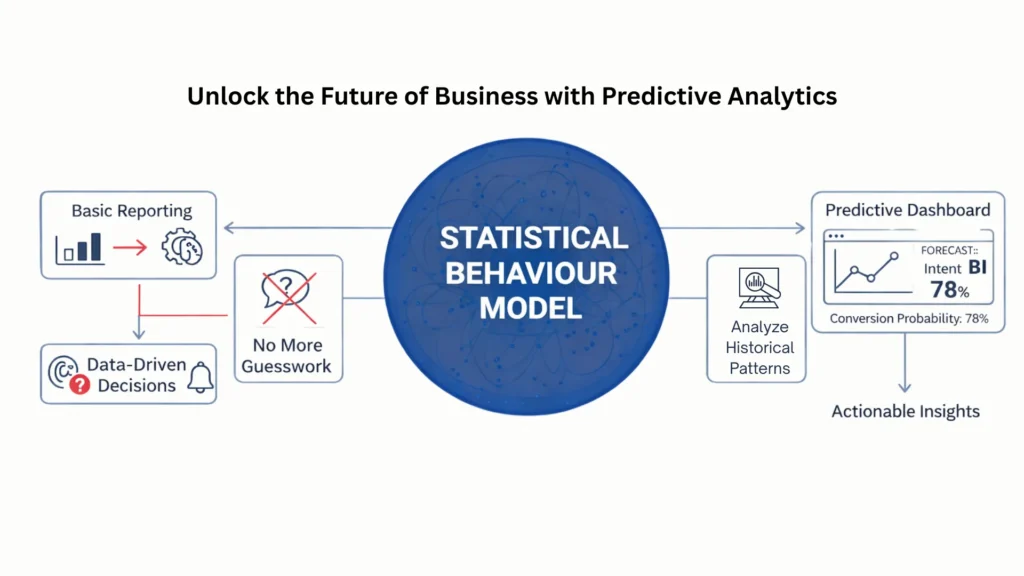
BI tools such as Power BI help visualize and act on user behaviour through predictive modelling. Using BI, teams can create user-friendly dashboards that allow them to quickly assess user behaviours by presenting data in a single view.
These predictive dashboards enable teams to make it possible to monitor behaviour as it happens. For example, companies can track churn risk, lifetime value, or behaviour clusters instantly and accelerate decision-making.
By combining models with BI, companies get data-driven behaviour forecasting that’s not just theoretical but it drives real decisions and quicker responses. This way, insights go from numbers on a sheet to actionable business moves.
To make statistical behaviour models work well, you always need the right data. This includes:
Clean, organized, and unified data is essential because messy or scattered data can lead to wrong predictions. Good data preparation makes sure your models are accurate and reliable.
Many businesses make simple mistakes that reduce prediction accuracy. Some common behaviour forecasting mistakes are:
Avoiding these common pitfalls can improve model accuracy and make insights truly useful for decision-making.
Implementing data-driven behaviour forecasting can be simple if you follow a clear workflow:
Following this behaviour modelling workflow helps businesses turn data into actionable insights.
User behaviour prediction isn’t just a nice-to-have anymore for businesses but rather a way to gain a competitive edge. Behaviour models turn raw data into forecasts that help businesses make smarter decisions, personalize experiences, and reduce risks.
Using BI tools amplifies this value by making predictions easy to understand and act on. Companies that adopt predictive analytics can stay ahead of competitors by anticipating user needs rather than reacting after the fact.